If you own or manage a commercial building in Utah, there is a good chance it has a flat or low-slope roof. Warehouses, retail centers, office buildings, and many multifamily properties rely on them. When that roof reaches the end of its life, one of the first decisions is which membrane to put on next.
The three most common options are TPO, EPDM, and modified bitumen. All three can do the job. The right one depends on your building, your budget, and where in Utah you are. A roof in Salt Lake County has to handle snow load, freeze-thaw cycles, and summer heat. A roof in St. George deals with intense sun, triple-digit temperatures, and monsoon downpours.
At Timberline Roofing, we install TPO and modified bitumen roofing systems for Utah business owners and property managers. We chose those two because they perform best across Utah’s mix of heat, sun, and snow. Here is how TPO, EPDM, and modified bitumen compare, and how to decide which one makes sense for your property.
TPO (Thermoplastic Polyolefin)
TPO is a single-ply membrane, usually white, that is rolled out over insulation and either mechanically fastened or fully adhered to the roof. Its seams are heat-welded with hot air, which fuses the sheets into one continuous surface.
TPO has become the most popular choice for commercial flat roofs across the country, and Utah is no exception.
Why building owners choose TPO:
- Energy efficiency. White TPO reflects a large share of the sun’s heat, which can help lower cooling costs. That matters on big, flat roofs that sit in full sun all day.
- Strong seams. Heat-welded seams are often stronger than the membrane itself, which means fewer weak points for water to find.
- Cost-effective. TPO typically falls in the middle of the price range, with good performance for the cost.
- Lightweight. It adds little weight to the structure, which makes it a good option for re-roofing.
Things to keep in mind:
- Quality varies between manufacturers and membrane thicknesses. Thicker membranes generally hold up longer.
- TPO has a shorter track record than EPDM or modified bitumen, since it has been widely used for a shorter time.
- Like any membrane, it can be punctured by heavy foot traffic or dropped tools. Walkway pads around HVAC units help.
Utah fit: TPO is a strong match for most Utah commercial buildings, and an especially good one in southern Utah, where reflecting heat is a top priority. With proper installation and maintenance, TPO roofs commonly last 20 to 30 years.
EPDM (Rubber Roofing)
EPDM is a synthetic rubber membrane, most often black, that has been used on commercial roofs for decades. It comes in large sheets, so a roof may have fewer seams overall. Instead of being welded, its seams are joined with adhesive and seam tape.
Why building owners choose EPDM:
- Long track record. EPDM has been around a long time, and well-installed EPDM roofs often last 25 to 30 years or more.
- Flexible in the cold. Rubber stays flexible in freezing temperatures, which helps it handle Utah’s freeze-thaw cycles without cracking.
- Easy to repair. Small punctures and tears can usually be patched quickly.
- Hail resistance. Its rubbery surface tends to absorb impact well.
Things to keep in mind:
- Heat absorption. Black EPDM absorbs sunlight, which can raise cooling costs in hot weather. White EPDM exists but is less common and costs more.
- Seams are the weak spot. Adhesive-bonded seams can loosen over time, especially with repeated heating and cooling, so they need periodic inspection.
- Shrinkage. As EPDM ages, it can shrink and pull away at the edges and around penetrations.
Utah fit: EPDM can be a solid choice for buildings in northern Utah, where cold-weather flexibility matters and summer heat is less extreme. In southern Utah, black EPDM’s heat absorption is a real drawback. Timberline Roofing does not install EPDM. For most Utah buildings, we find that TPO or modified bitumen offers better heat performance or durability for the cost.
Modified Bitumen
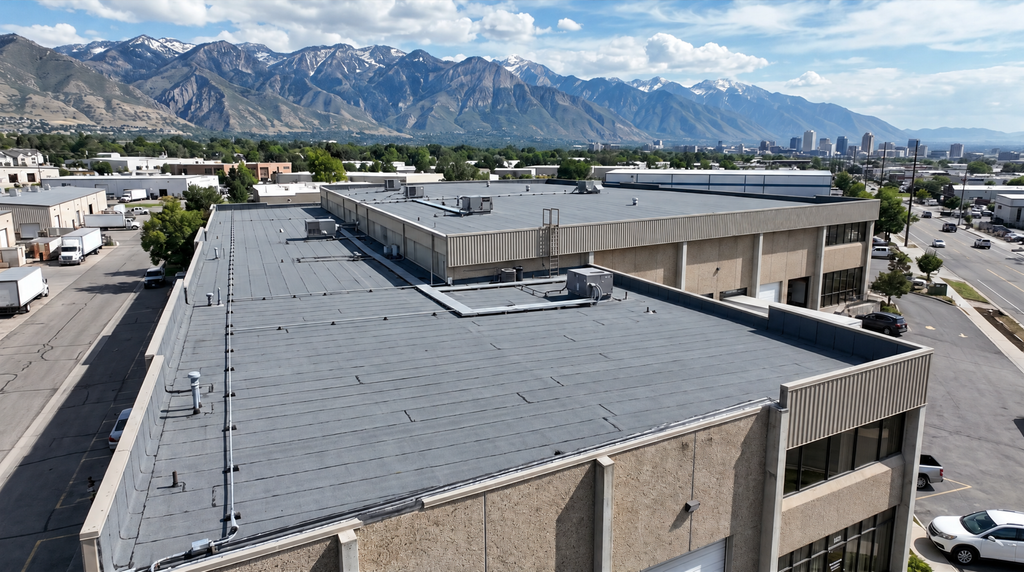
Modified bitumen is an asphalt-based roofing system reinforced with rubber or plastic polymers. It is the modern evolution of the old tar-and-gravel built-up roof. Unlike TPO and EPDM, it is usually installed in multiple layers, with a base sheet and a mineral-surfaced cap sheet on top. Layers are applied with heat, cold adhesive, or self-adhering sheets.
Why building owners choose modified bitumen:
- Toughness. Multiple layers make it very resistant to punctures and tears.
- Handles foot traffic. It is a good fit for roofs with frequent maintenance visits, rooftop equipment, or service walkways.
- Redundancy. If the top layer is damaged, there is still another layer underneath protecting the building.
- Familiar and repairable. Most commercial roofers know it well, and patches are straightforward.
Things to keep in mind:
- Shorter lifespan. Modified bitumen roofs typically last 15 to 25 years, often less than single-ply membranes.
- Heavier. Multi-layer systems weigh more, which can matter on older structures.
- Heat absorption. Standard dark cap sheets absorb sunlight. Reflective white cap sheets and coatings are available to offset that.
- Installation. Torch-applied systems require extra fire safety precautions, which is one reason many projects now use cold-applied or self-adhering sheets.
Utah fit: Modified bitumen works well on smaller commercial roofs and roofs with heavy foot traffic or lots of rooftop equipment. With a reflective cap sheet, it can perform in southern Utah too.
TPO vs. EPDM vs. Modified Bitumen at a Glance
| TPO | EPDM | Modified Bitumen | |
| Typical lifespan | 20–30 years | 25–30+ years | 15–25 years |
| Typical color | White | Black | Dark (reflective cap available) |
| Heat reflection | Excellent | Poor (black) | Fair to good with reflective cap |
| Cold flexibility | Good | Excellent | Good |
| Seams | Heat-welded | Adhesive and tape | Layered and sealed |
| Foot traffic | Moderate | Low to moderate | Excellent |
| Relative cost | Moderate | Low to moderate | Low to moderate |
| Best Utah fit | Most buildings; ideal in southern Utah | Northern Utah, cold-climate priorities | High-traffic roofs, smaller roofs |
Lifespans assume proper installation and regular maintenance. Actual cost depends on roof size, insulation, tear-off, and access.
How to Choose the Right Flat Roof for Your Utah Building
Start with location. In St. George and Washington County, heat reflection is usually the deciding factor, which points toward white TPO or a reflective cap sheet. Along the Wasatch Front, snow load, freeze-thaw cycles, and summer heat all matter, so any of the three can work.
Think about how the roof is used. If technicians are on the roof every month servicing HVAC units, durability under foot traffic moves up the list. If the roof rarely sees visitors, energy savings may matter more.
Look at the whole system. The membrane is only one part. Insulation, drainage, flashing, and installation quality often matter more than which membrane you pick. A great membrane installed poorly will not last.
Plan for the long run. A slightly higher upfront cost can pay off if it means lower energy bills and fewer repairs over 20-plus years.
The best way to decide is with an inspection. We look at your current roof, structure, drainage, and how you use the space, then walk you through the options that fit.
Keep Any Flat Roof Lasting Longer
No matter which membrane you choose, maintenance is what gets you to the long end of its lifespan:
- Inspect twice a year. Spring and fall inspections catch winter and summer damage before it turns into leaks.
- Keep drains and scuppers clear. Standing water is one of the biggest threats to a flat roof.
- Check after major storms. Hail, high winds, and heavy snow can damage membranes and flashing.
- Protect high-traffic areas. Walkway pads around rooftop equipment help prevent punctures.
- Watch seams and flashing. Most flat roof leaks start at seams, edges, and penetrations, not in the middle of the membrane.
A commercial roof maintenance plan takes these off your plate and documents the roof’s condition over time, which helps with budgeting and warranty claims.
Frequently Asked Questions
Which flat roof lasts the longest?
EPDM has the longest track record, often lasting 25 to 30 years or more. A quality TPO roof can last 20 to 30 years. Installation and maintenance matter as much as the material.
What is the best flat roof for hot climates like St. George?
White TPO is usually the top choice because it reflects heat and helps lower cooling costs. Modified bitumen with a reflective cap sheet is another option.
Can a new flat roof go over my existing roof?
Sometimes. Depending on the current roof’s condition and local building code, a recover may be possible. An inspection will tell you whether a tear-off is needed.
How do I know if my flat roof needs replacing or just repairs?
Widespread leaks, soft spots, large areas of standing water, or a membrane that is cracking or shrinking usually point to replacement. Isolated leaks can often be repaired.
Protect Your Utah Commercial Property
Your commercial roof protects your tenants, inventory, equipment, and bottom line. Choosing the right system, and keeping it maintained, saves money for years.
Timberline Roofing installs, replaces, repairs, and maintains TPO and modified bitumen commercial roofs for businesses across Salt Lake County, Utah County, Park City, and St. George. All of our work is done in-house, and we offer financing options.
Not sure whether TPO or modified bitumen is the better fit for your building? Call us at (801) 860-4319 or schedule your free commercial roof inspection today.